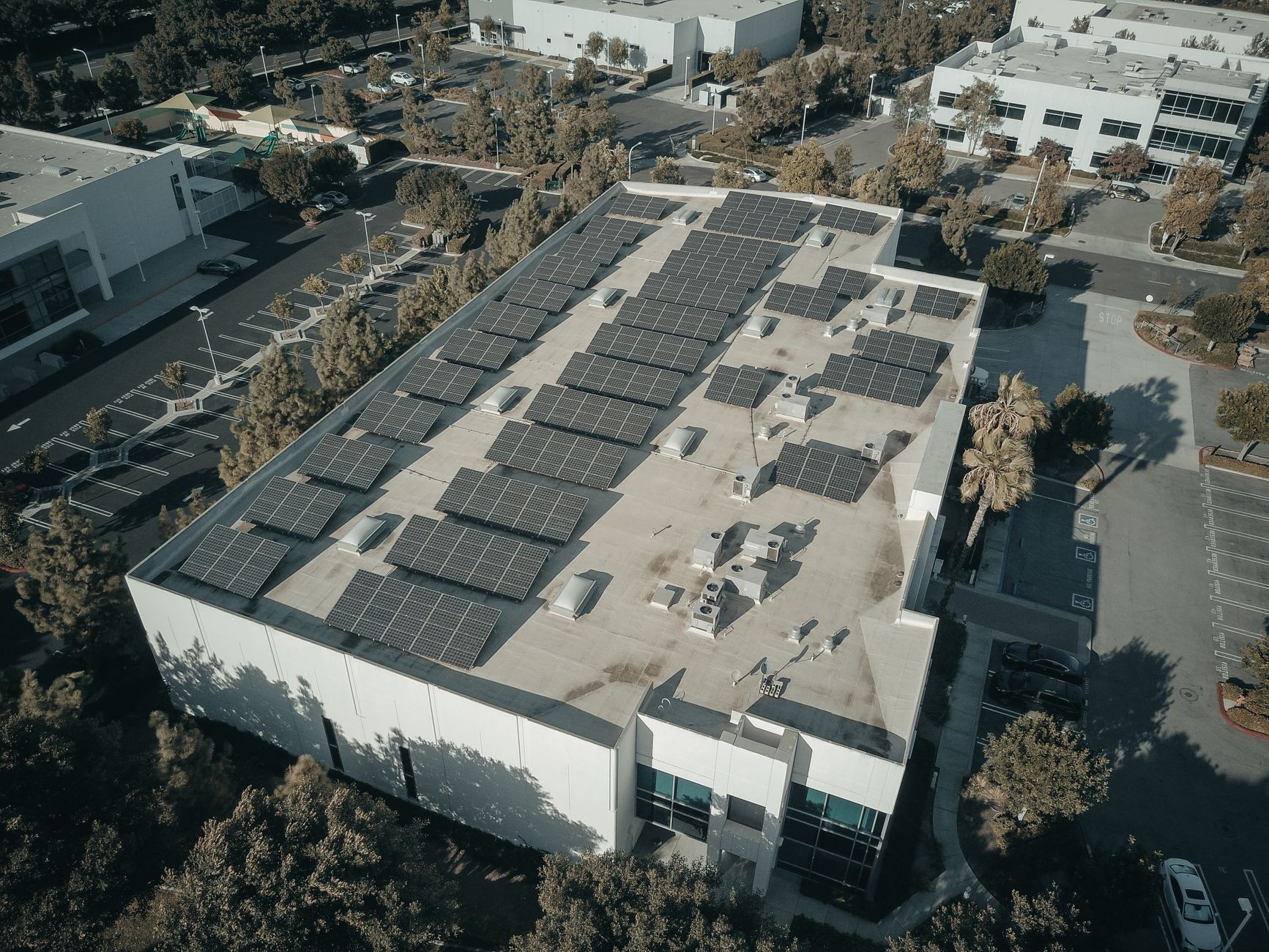
Most commercial solar conversations focus on the equipment. Panel efficiency, inverter brands, warranty terms. Those matter, but they are rarely what determines whether your system turns on in March or in September.
Interconnection usually decides that. It is the process of getting your utility to formally agree that your system can connect to their grid and export power under a specific rate structure. Until that agreement is executed and the utility gives permission to operate, your array can be fully installed, inspected, and sitting on the roof doing nothing.
Owners are often surprised by this. It helps to know what the step actually involves before you sign a contract that quotes you a timeline.
What the utility is actually evaluating
An interconnection application is a technical review, not a formality. The utility is looking at what happens to their distribution circuit when your system starts pushing power onto it.
The main questions they are answering:
Can the local circuit absorb the export? Your building sits on a feeder shared with other customers. If that feeder already carries a lot of distributed generation, adding several hundred kilowatts changes the voltage profile. The utility models this.
Does your service equipment support the interconnection? This is where a lot of commercial projects hit friction. Your main service panel, the busbar rating, and the available breaker space all have to accommodate the new source. On older buildings, the answer is frequently no without an upgrade.
Is protection and metering configured correctly? Larger commercial systems often require specific protective relaying, and sometimes a dedicated production meter.
If everything checks out on the initial screens, the application moves forward relatively cleanly. If it does not, the project goes into a more detailed study, and that is where timelines stretch.
Where projects actually stall
In our experience, three things cause the most delay, and none of them are the utility being difficult.
Incomplete applications. Utilities review what you submit. A single-line diagram with a missing detail, a site plan that does not match the equipment list, an unsigned document buried in the packet — any of these can send the application back to the start of the review queue rather than to the top of the reviewer's pile. The rework is not the expensive part. The requeue is.
Service upgrades discovered late. If nobody assessed your electrical service before design, you can get deep into the process and learn that your panel cannot accept the system as drawn. Now you are coordinating a service upgrade with the utility, which is its own timeline, while your interconnection application waits.
Design changes after submission. Moving panels, changing inverter counts, revising the string layout after you have applied usually means resubmitting. Every revision restarts a clock.
The pattern in all three: the delay is created upstream, during design and application prep, and only becomes visible later.
Interconnection and permitting are not the same thing
This trips up owners regularly. Your local building department issues the construction permit. The utility handles interconnection. They are separate agencies with separate reviews, separate requirements, and separate timelines.
A well-run project runs both in parallel and sequences them so neither is waiting on the other unnecessarily. A poorly-run project treats them as a checklist and discovers in month four that the permit was approved in month two while the interconnection application was never filed.
When a project has multiple companies involved — one selling, one designing, one installing, one handling paperwork — this is exactly the seam where things get dropped. Nobody owns the handoff, so the handoff does not happen.
Questions worth asking before you sign
If you are evaluating proposals, these questions will tell you a lot about how a contractor actually operates:
Who prepares and submits the interconnection application? If the answer is a subcontractor or a third-party permitting service, ask who follows up when the utility sends comments back.
Has anyone assessed our existing electrical service yet? If the proposal was built off a satellite image and a utility bill, the service assessment has not happened. That is not automatically a problem, but it means the timeline you were quoted is an estimate built on an assumption.
What is your timeline assumption for interconnection specifically? A contractor who has run projects in your utility territory will give you a range and explain what moves it. A contractor who has not will give you a single confident number.
What happens to the schedule if the utility requires a supplemental study? The answer should be a plan, not a shrug.
Why this shapes how we work
We handle design, permitting, interconnection, and installation in-house, and we keep the same team on a project from the site assessment through permission to operate. That is not a philosophical position — it is a response to watching how projects fail. When the person who designed the system is the same person answering the utility's comments, the comments get answered correctly the first time.
Interconnection is not glamorous, and no proposal wins on it. But it is frequently the difference between a system that produces during your highest-cost season and one that misses it entirely.
If you are evaluating commercial solar for a facility in Southern California and want a realistic read on what your interconnection path looks like, we are glad to walk through it with you before you commit to anything.