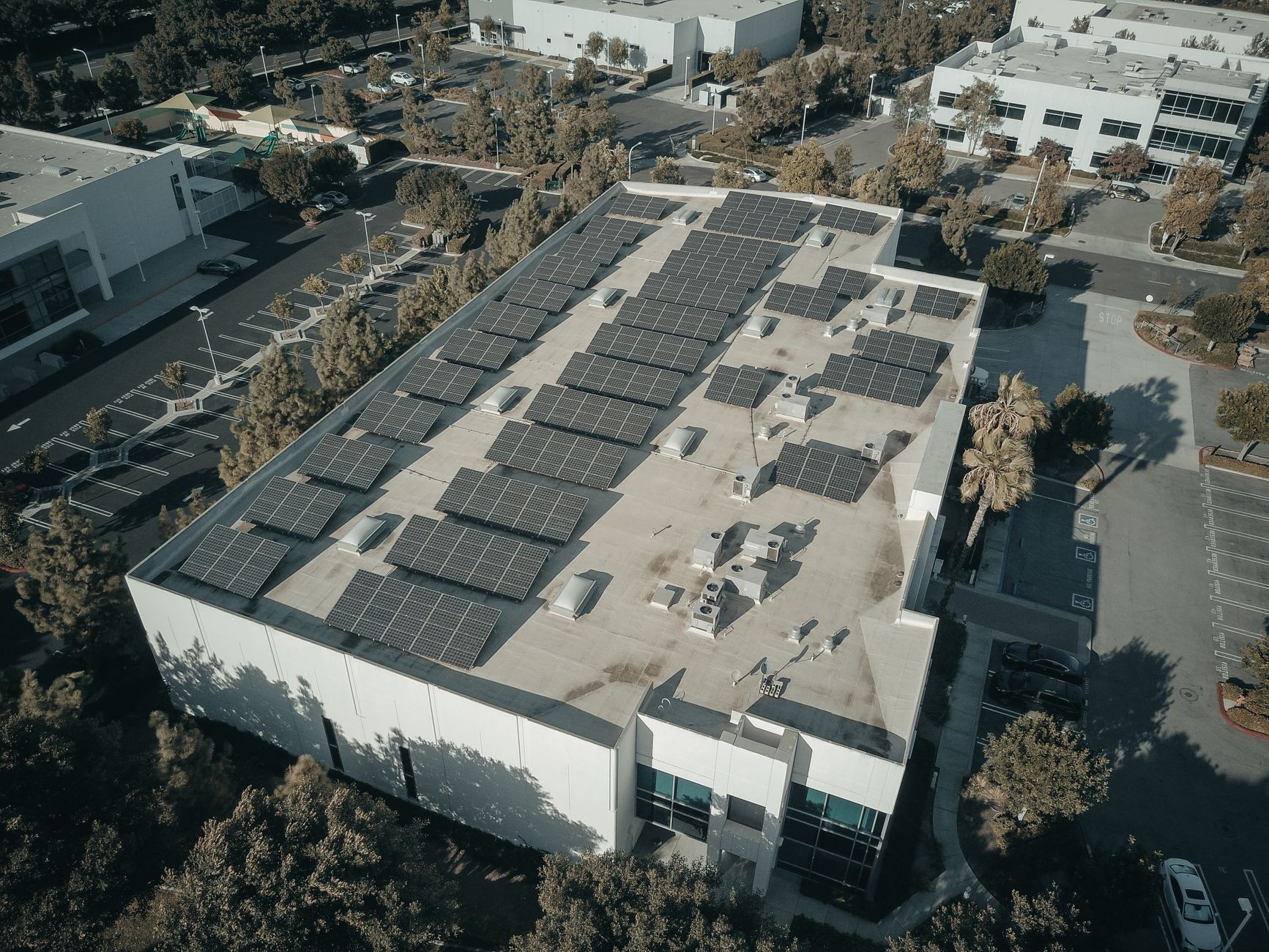
If you priced commercial solar a few years ago and shelved it, the math has changed. California moved from net metering to a net billing structure, often called NEM 3.0, and the value of exporting solar power back to the grid dropped sharply.
This does not mean commercial solar stopped working. It means the strategy changed. The systems that perform best now are designed to use power on site rather than sell it back. Here is what actually changed and how facility owners in Southern California Edison territory should think about it.

From Net Metering to Net Billing
Under the old net metering rules, exported solar earned credits at close to the retail rate. A kilowatt-hour you sent to the grid at noon offset a kilowatt-hour you bought at night at nearly the same value. That made oversizing a rooftop array a reasonable strategy, because surplus production was almost as valuable as the power you used directly.
Under net billing, exported energy is valued closer to what the grid would have paid a wholesale supplier at that exact hour. During sunny midday hours, when many commercial systems produce their surplus, that value is low. The power you consume directly behind your meter is still worth the full retail rate you avoid paying. The power you export is worth much less. That single change rewrites how a commercial system should be designed.
Why Self-Consumption Became the Goal
The practical takeaway is simple. Every kilowatt-hour your facility uses the moment it is produced is worth far more than one you send to the grid. So the design question shifted from how much can the roof hold to how much can the building actually use during daylight hours.
- Match system size to daytime load, not to roof area
- Shift flexible loads, such as EV charging or irrigation pumping, into solar hours
- Use storage to capture midday surplus for evening use
A facility that runs hard during the day already consumes most of what it produces. A facility that goes quiet at midday needs storage to capture the value, which is why the right answer depends on your actual operating pattern.
The Role of Battery Storage Under NEM 3.0
Batteries are the piece that makes net billing work in your favor. Instead of exporting cheap midday surplus, you store it and use it when the sun goes down, displacing expensive grid power and reducing demand charges.
Demand charges are the quiet driver
Most commercial Southern California Edison accounts pay demand charges based on the highest fifteen-minute power draw in a billing period. A single afternoon spike can set the charge for the whole month. A battery can discharge during those peaks to shave them down, which often delivers savings that solar alone cannot. For many commercial accounts, demand charges are a large share of the bill, and they are nearly invisible until you look closely.
This is why so many new commercial projects in Temecula and the Inland Empire pair solar with storage from the start. The combination protects the economics that net billing weakened and adds a second savings stream on top of energy offset.
Time-of-Use Rates Make Timing Everything
Commercial customers are on time-of-use rate schedules, where electricity costs more during late afternoon and early evening peak periods. Solar produces most of its power before those peaks arrive. Storage bridges the gap by holding solar energy and releasing it during the costliest hours, which is exactly when grid power hurts the most.
Without storage, a solar-only system delivers its cheapest power back to the grid at midday and leaves you buying expensive power at peak. With storage, you flip that, using your own stored energy when rates are highest. The value of a battery is therefore tied directly to the spread between your off-peak and peak rates, which is wide on most commercial schedules.
Does Commercial Solar Still Pay Under NEM 3.0?
For most commercial facilities, yes, but the payback now depends on good design rather than generous export credits. A well-designed self-consumption system, often with storage, still produces strong returns because it offsets retail-rate power and trims demand charges. The federal Investment Tax Credit and depreciation benefits also remain available and meaningfully shorten payback.
The systems that disappoint under net billing are the ones designed for the old rules, sized to export rather than to serve the building. The fix is design discipline, not abandoning solar. An installer who understands net billing will model your specific rate schedule and load, then size the array and battery to maximize on-site value rather than total production.
What Facility Owners Should Ask
- What share of my production will I use on site versus export?
- How does the proposal handle demand charges, not just energy charges?
- Is storage modeled against my actual time-of-use schedule?
- What is the payback with and without a battery?
- Was the system sized for net billing or copied from old net metering assumptions?
If a proposal cannot answer these, it was probably built for net metering, not net billing. The rules have changed, and the design needs to change with them. Done right, commercial solar in California still delivers a strong return. It just has to be engineered for the world we are actually in.
Sources
- California Public Utilities Commission, Net Billing Tariff decision
- Southern California Edison, time-of-use commercial rate schedules
- U.S. Department of Energy, Solar Energy Technologies Office
- Lawrence Berkeley National Laboratory, behind-the-meter storage research